


LiFePO4 Solar Battery Certifications From YouthPOWER LiFePO4 Solar Battery Factory
For solar battery buyers, distributors, EPC contractors, and solar project developers, understanding which LiFePO4 battery certifications are required in different markets is critical before procurement.
As a certified LiFePO4 battery supplier, YouthPOWER supplies certified LiFePO4 solar batteries for residential and commercial energy storage applications worldwide. Certifications such as UN38.3, UL 1973 / UL 9540 / UL 1642, IEC 62619, CE-EMC, and MSDS directly affect international shipping, customs clearance, project approval, installation safety, and legal compliance.
This guide explains what each certification means, where it is required, and why it matters for procurement decisions.
UN38.3 Certification for Lithium Battery Shipping
UN38.3 is a mandatory transportation safety standard for shipping lithium batteries worldwide, including LiFePO4 batteries.
For procurement teams, UN38.3 compliance means:
- ● Only UN38.3-certified batteries can be legally transported by air (IATA), sea (IMDG), or road transport
- ● Reduces the risk of shipment rejection, delays, or regulatory penalties
- ● Confirms batteries have passed key safety tests, including altitude simulation, temperature cycling, vibration, shock, short circuit, and impact
Because UN38.3 applies to every lithium battery shipment, verifying a valid UN38.3 test report is a fundamental requirement before placing any order.
Why Buyers Should Care
- ● Mandatory for international lithium battery transportation
- ● Protects logistics planning and project timelines
- ● Minimizes risks during customs inspections and carrier acceptance
⭐ Procurement Tip:
Never place an order without a valid and up-to-date UN38.3 test report issued by an accredited laboratory.
YouthPOWER UN38.3 Compliance Advantage
At YouthPOWER, all standard residential LiFePO4 battery products are fully UN38.3 certified, ensuring smooth and compliant global shipping.
In addition, our commercial energy storage system (ESS) standard models are certified for UN transportation at the complete cabinet level, allowing:
- √ Fully assembled cabinet shipment
- √ No on-site disassembly or reassembly
- √ Lower shipping costs
- √ Reduced on-site labor and installation time
This helps solar battery distributors, EPC contractors, and project developers simplify logistics, reduce total project cost, and accelerate deployment.
UL Certifications for the North American Market
UL certifications are essential for selling or installing LiFePO4 batteries in the United States and Canada, especially for commercial and residential energy storage projects.

UL 1642 – Lithium Cell Safety
UL 1642 applies to individual lithium battery cells, including LiFePO4 cells used in energy storage systems.
It is commonly required for:
- ● Cell qualification by battery pack manufacturers
- ● System integrator and inverter compatibility requirements
- ● Safety validation at the component level
UL 1642 focuses on cell-level safety, covering tests such as short circuit, overcharge, and mechanical abuse.
It provides the foundation for higher-level certifications such as UL 1973 and UL 9540.
-----------------------------------------------------------------------------------------------------------------------------------------------------
UL 1973 – Stationary Energy Storage Batteries
UL 1973 applies to battery packs used in stationary energy storage systems, including residential solar ESS, commercial backup power, and telecom applications. In many U.S. and Canadian projects, UL 1973 certification is required for system approval and local inspection.
For buyers targeting the North American market, choosing a UL 1973 certified LiFePO4 battery helps streamline compliance, reduce project risk, and ensure smooth installation.
It is widely required for:
- ● Solar energy storage systems
- ● Residential and commercial ESS projects
- ● Utility and telecom backup power applications
UL 1973 focuses on pack-level safety, ensuring batteries operate safely under normal and foreseeable conditions, making it a key certification for energy storage projects in the North American market.
-----------------------------------------------------------------------------------------------------------------------------------------------------
UL 9540 – Energy Storage System (ESS) Safety
UL 9540 applies to complete energy storage systems, including batteries, battery management systems (BMS), inverters, and related control and protection components.
It is widely required for:
- ● Grid-connected energy storage projects
- ● Commercial and utility-scale ESS installations
- ● Projects subject to fire code and insurance approval
UL 9540 focuses on system-level safety, evaluating interactions between components, thermal management, and protective functions. For many projects in the United States and Canada, UL 9540 listing is mandatory for project approval and commissioning.
YouthPOWER UL-Certified Product Advantage for the North American Market
At YouthPOWER, all our standard residential and commercial LiFePO4 battery products are designed to meet UL safety requirements, ensuring compliance with the strict standards of the North American market.
All battery cells used in our products are sourced from Top 10 lithium cell manufacturers in China, such as BYD, EVE, CATL, ANC, and other tier-one suppliers.
These cells are:
- ♦ Automotive-standard
- ♦ Brand-new Grade A cells
- ♦ Fully compliant with UL 1642 cell-level safety requirements
This ensures a high level of safety, consistency, and long-term reliability for every battery system.
For the North American residential solar market, YouthPOWER has developed several UL-certified flagship models, specifically designed to meet local installation, fire safety, and grid requirements. These models include:
- >> 5kWh / 10kWh LiFePO4 Powerwall batteries Version 1
- >> 5kWh / 10kWh LiFePO4 Powerwall batteries Version 2
- >> 5kWh / 10kWh LiFePO4 server rack batteries
- >> 10kWh waterproof LiFePO4 batteries
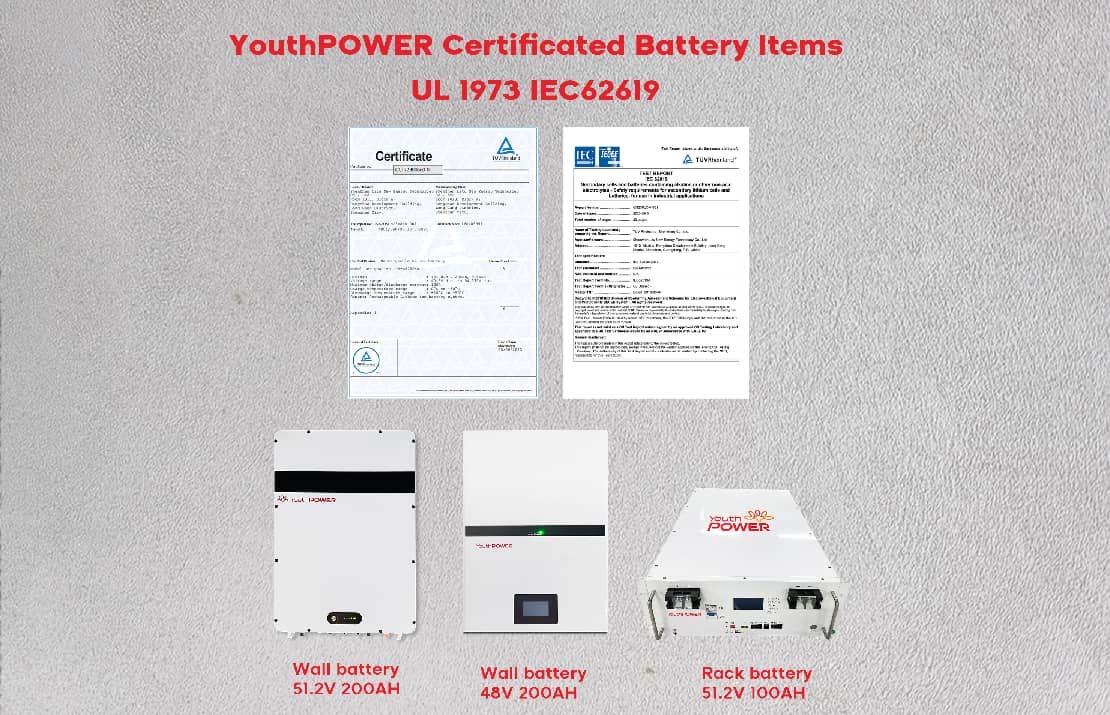
YouthPOWER UL 1973 IEC 62619 Certificated Battery Items
These products are certified with UL 1973, and selected models are also UL 9540 listed, making them suitable for residential, commercial, and grid-connected ESS projects in the U.S. and Canada. In the North American market, these models have become best-selling and high-repeat-order products, widely adopted by distributors, installers, and EPC partners.
Many partners have shared successful installation cases, reporting stable operation, smooth commissioning, and positive feedback from end users. This real-world performance further demonstrates the safety, reliability, and market readiness of YouthPOWER LiFePO4 energy storage solutions.
IEC 62619 for Industrial Energy Storage Batteries
CB certification - IEC 62619 applies to industrial lithium batteries, including LiFePO4 batteries used in solar and energy storage systems.
Applicable Markets
IEC 62619 is required or widely accepted in:
European Union, United Kingdom, Australia, Japan, Southeast Asia, Middle East & Africa
Why It Matters for Buyers
IEC 62619 evaluates electrical, mechanical, and environmental safety under industrial operating conditions.
It is commonly specified in:
- ● Commercial and industrial ESS projects
- ● Government and utility tenders
- ● Off-grid and backup power systems
For buyers and EPC contractors, IEC 62619 helps ensure long-term reliability, regulatory acceptance, and reduced operational risk across international markets.

YouthPOWER UL 1973 IEC 62619 Certifications for 10kwh 51.2V 200Ah
YouthPOWER IEC 62619 Compliance
YouthPOWER lithium solar batteries are certified to CB - IEC 62619, meeting international safety requirements for industrial lithium battery applications.
This certification confirms compliance with electrical, mechanical, and environmental safety standards, supporting reliable deployment in commercial, industrial, and solar energy storage projects across global markets.
CE-EMC Certification for the European Market
CE-EMC certification confirms compliance with European electromagnetic compatibility regulations, ensuring that energy storage products do not interfere with other electrical equipment.
Applicable Markets
CE-EMC is mandatory in: European Union, United Kingdom (UKCA EMC equivalent may apply)
Why It Matters for Buyers
CE-EMC is a legal requirement for selling and installing LiFePO4 batteries in Europe.
Without CE-EMC:
- × Products cannot enter the EU market
- × Projects may fail regulatory inspections
- × Distributors face legal and compliance risks
CE-EMC certification is therefore essential for market access and project approval in Europe. CE-EMC certification is required for lithium batteries entering the European Union and confirms compliance with electromagnetic compatibility standards.
YouthPOWER CE Compliance for the European Market
YouthPOWER offers CE certified LiFePO4 batteries that comply with applicable European directives, including electromagnetic compatibility (EMC) and product safety requirements. Our solar battery models are specifically engineered for the European solar energy market and are widely deployed in residential and commercial applications across EU countries. Numerous successful installations are documented in our European installation cases, demonstrating stable performance, seamless system integration, and consistent positive feedback from installers and end users. These real-world projects further validate product reliability and full regulatory readiness for the European market.
MSDS – Material Safety Data Sheet for Lithium Battery Transportation
MSDS (Material Safety Data Sheet) provides detailed information on the composition, hazards, handling, storage, and emergency response for lithium batteries.
Applicable Markets
MSDS is required for:
- ▲ Global lithium battery transportation
- ▲ Customs clearance and logistics
- ▲ Warehousing and workplace safety
across all major international markets.
Why It Matters for Buyers
MSDS supports:
- ● Compliance with transport and safety regulations
- ● Safe handling by logistics and installation teams
- ● Risk management and liability protection
For buyers and distributors, MSDS is a foundational compliance document and should always be requested alongside UN38.3 reports.
YouthPOWER MSDS Compliance
Every YouthPOWER product is provided with a complete MSDS, as required for lithium battery transportation and international trade. We strictly adhere to global regulatory standards, ensuring full legal compliance, rigorous risk management, and responsible safety practices.
Buyers and partners can access relevant technical documents to support customs clearance, logistics coordination, and project documentation requirements.
LiFePO4 Battery Certification Requirements by Region
| Region | Required Certifications |
| USA & Canada | UN38.3, UL 1642, UL 1973, UL 9540, MSDS |
| European Union | UN38.3, IEC 62619, CE-EMC, MSDS |
| UK | UN38.3, IEC 62619, CE-EMC / UKCA, MSDS |
| Australia | UN38.3, IEC 62619, MSDS |
| Japan & Korea | UN38.3, IEC 62619, MSDS |
| Middle East & Africa | UN38.3, IEC 62619, MSDS |
FAQ About Lithium Battery Certifications
Q1: Can I import LiFePO4 batteries without UN38.3?
A1: No. UN38.3 is mandatory for international shipping in almost all countries.
Q2: Is UL certification required outside the U.S.?
A2: UL is mainly required in the U.S. and Canada, but some international projects still request it.
Q3: Is IEC 62619 accepted globally?
A3: Yes. It is one of the most widely recognized industrial lithium battery standards.
Q4: Is CE-EMC mandatory for Europe?
A4: Yes. CE-EMC is legally required to sell batteries in the EU.
Q5: Why should distributors request MSDS?
A5: MSDS supports customs clearance, safe handling, and regulatory compliance worldwide.
Post time: Mar-12-2026